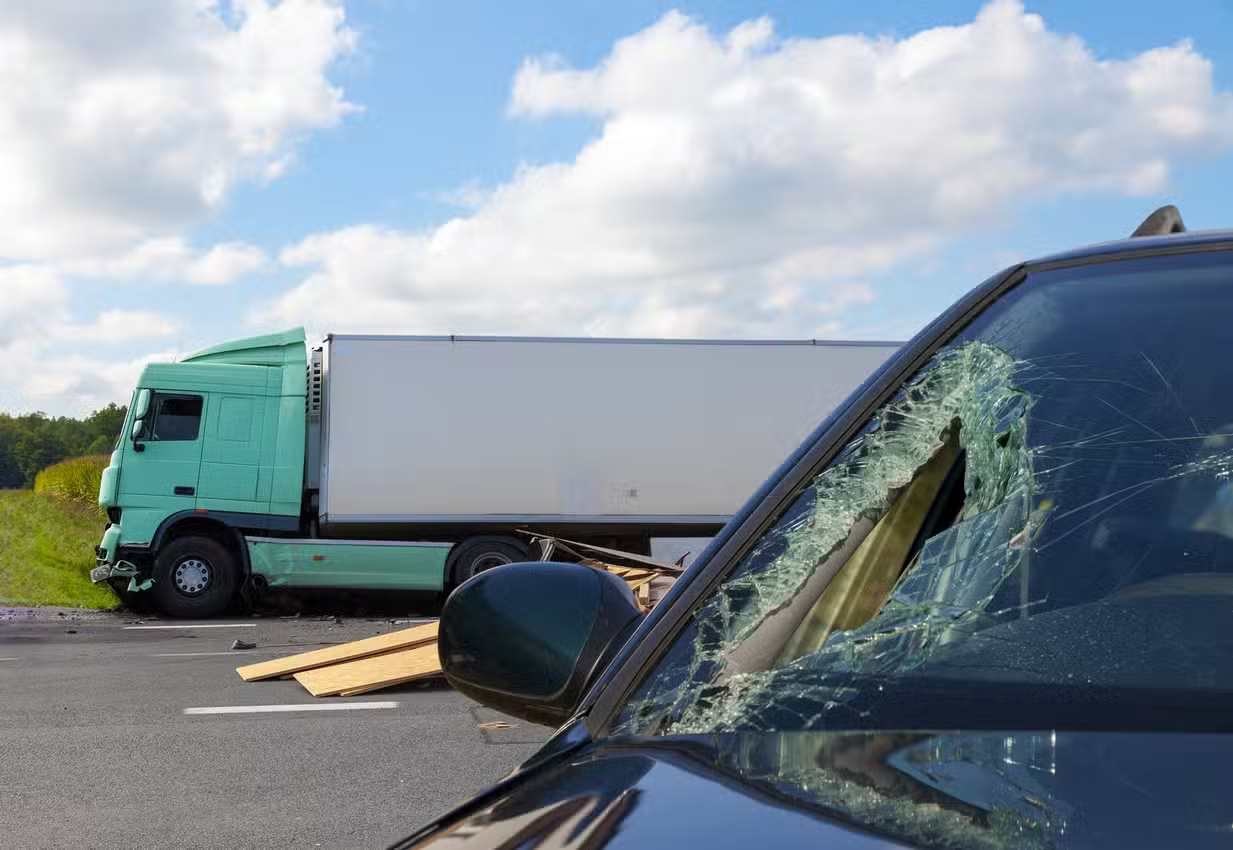

A federal hours-of-service (HOS) violation is one of the strongest pieces of evidence in a California truck accident case. When a truck driver exceeded legal driving limits before a crash, that violation can establish negligence per se, shifting the burden of proof significantly in favor of the injured victim.
What Are the Federal Hours-of-Service Rules for Truck Drivers?
The Federal Motor Carrier Safety Administration sets strict daily and weekly driving limits to prevent fatigue-related crashes, and California enforces these same standards for all commercial trucks operating in the state.
- Maximum 11 hours of driving after 10 consecutive hours off duty
- No driving beyond the 14th consecutive hour after coming on duty
- Required 30-minute rest break after 8 cumulative hours of driving time
- Maximum 60 hours of driving in any 7 consecutive days or 70 hours in 8 consecutive days
- A 34-hour restart provision allows drivers to reset weekly limits after a qualifying rest period

What Is Negligence Per Se and How Does It Apply to HOS Violations?
Negligence per se means that violating a safety regulation is treated as automatic proof of negligence, removing the need to separately argue the driver's conduct was unreasonable.
- Federal HOS rules exist specifically to prevent fatigued driving and the injuries it causes
- When a driver violates HOS rules and causes a crash, that violation satisfies the negligence element of your claim
- You still must prove the HOS violation caused your specific injuries
- Negligence per se claims against trucking companies are possible when they knowingly permitted or encouraged HOS violations
What Records Prove a Driver Violated Hours-of-Service Rules?
ELD data, paper logs, and dispatch records are the three most important sources of proof in an HOS violation case.
- ELD (Electronic Logging Device) data records every minute of engine-on and driving time with GPS precision
- Paper logbooks, now supplemental to ELDs, may reveal inconsistencies when compared to ELD records
- Dispatch records and delivery manifests show whether the schedule demanded an impossible timeline
- Fuel receipts, toll records, and weigh station data can independently corroborate or contradict official logs
- Driver cell phone records may show use while driving, compounding the fatigue evidence

How Can the Trucking Company Be Liable for Its Driver's HOS Violations?
Trucking companies that set delivery schedules knowing they require HOS violations can be held directly liable, not just vicariously liable for the driver's conduct.
- Direct negligence applies when a company schedules routes that cannot be completed within legal driving hours
- Supervisors who signed off on falsified logbooks share in the company's liability
- Failure to audit ELD data for violations shows systemic disregard for driver and public safety
- Punitive damages may be available when the company's conduct was reckless or fraudulent
HOS violations are among the most powerful evidence in a truck accident case, but the records that prove them are only preserved for a short window after a crash. Contact the commercial vehicle accident attorneys at Avian Law Group as soon as possible to issue a spoliation notice and secure the evidence you need. We represent injured victims across California, Arizona, and Nevada with no fees unless you recover.

Michael Avanesian, the founder and driving force behind Avian Law Group, is a passionate and dedicated attorney with a strong background in personal injury law. As a partner at JT Legal Group, Michael led the growth of the personal injury practice from a single employee to a team of over ninety professionals, securing over $2 billion in settlements for clients in just three years.


.jpeg)