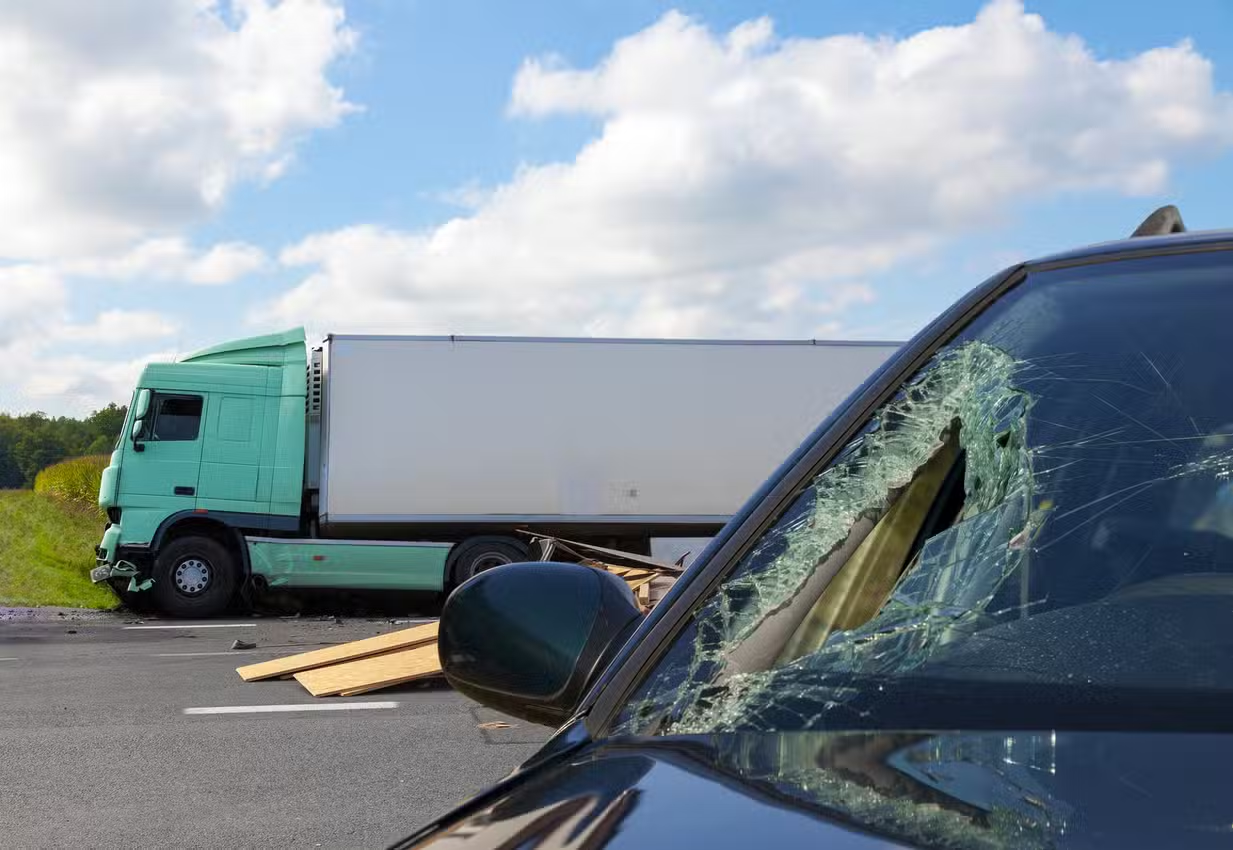

Accidents involving commercial trucks, tractor-trailers, delivery vans, and other large vehicles are not standard car accident cases with slightly bigger defendants. They involve multiple potentially liable parties, federally regulated industries with specific safety requirements, complex insurance structures with multiple layers of coverage, and injuries that are often catastrophic due to the size and weight differential between commercial vehicles and passenger cars. Understanding what sets these cases apart from typical auto accidents is the first step toward building a claim that captures the full value of your damages and holds every responsible party accountable.
Why Multiple Parties Can Be Liable
In a standard car accident, liability typically falls on one or both drivers involved in the collision. In a commercial vehicle accident, the web of potential defendants is substantially wider and requires thorough investigation to identify:
- The truck driver, who may be liable for negligent operation including speeding, distracted driving, driving under the influence, or violating hours of service regulations that limit how many consecutive hours a driver can operate without rest.
- The trucking company, which may be liable for inadequate hiring practices, insufficient driver training, failure to maintain the vehicle properly, or pressuring drivers to violate safety regulations to meet unrealistic delivery schedules.
- The cargo loading company, which may be liable if improper loading, unsecured cargo, or overweight loads caused the vehicle to become unstable, difficult to control, or created a hazard that contributed to the collision.
- The truck manufacturer or parts supplier, which may be liable under product liability theory if a mechanical defect such as brake failure, tire blowout, or steering system malfunction contributed to the accident.
- The maintenance contractor, if a third-party company was responsible for vehicle inspections and repairs and failed to identify or correct a dangerous condition before returning the truck to service.
Each of these parties carries its own commercial insurance policy, employs its own legal team, and has a strong financial interest in shifting blame to the other defendants to minimize their individual exposure. Navigating that structure and ensuring that your claim reaches every available insurance policy requires an attorney experienced in commercial vehicle litigation, not just general personal injury work.
Federal Regulations That Shape These Cases
Commercial truck drivers and motor carriers operating in California are subject to Federal Motor Carrier Safety Administration regulations governing hours of service, vehicle maintenance schedules, driver qualifications, cargo securing requirements, and mandatory alcohol and drug testing programs. Understanding how California trucking rules and regulations affect your case is critical because violations of these federal regulations can establish negligence per se, meaning the violation itself proves the breach of duty without requiring further argument about what a reasonable driver would have done under the same circumstances.
Hours of service logs documenting when the driver was on duty and off duty, maintenance records showing when the vehicle was inspected and what repairs were performed, driver qualification files containing background checks and medical certifications, cargo weight documentation, and data from the electronic logging device installed in most modern commercial trucks are all subject to preservation demands and potential discovery in litigation. This evidence exists in both digital and paper form, and trucking companies are required by federal law to retain it for specific periods.
However, absent a formal spoliation letter from an attorney demanding preservation, routine document destruction policies may eliminate critical evidence before you even know it exists. This is why contacting an attorney immediately after a commercial vehicle accident is so important. The evidence that proves your case may only exist for 30 to 90 days after the collision unless it is formally preserved through legal process.
The Severity of Injuries in Commercial Vehicle Collisions
The injuries that result from commercial vehicle collisions reflect the enormous size and weight differential between a fully loaded tractor-trailer, which can weigh 80,000 pounds, and a passenger vehicle weighing 3,000 to 4,000 pounds. Our resource on common truck accident injuries covers the full clinical picture, from spinal cord damage and traumatic brain injury to crush injuries, amputations, severe burns from post-collision fires, and internal organ damage that may not be immediately apparent but proves life-threatening. These outcomes routinely produce lifetime medical care costs, permanent disability, and non-economic damages that dwarf what a typical car accident claim involves.
Calculating the full value of a commercial vehicle accident claim requires assembling a team of experts. Economic experts project lifetime medical costs based on the injured person's age, health status, and specific medical needs. Life care planners, typically registered nurses with specialized training, detail the specific ongoing care, equipment, home modifications, and attendant care needs that will be required for the rest of the injured person's life. Vocational rehabilitation specialists assess lost earning capacity by evaluating what the person could have earned in their chosen career versus what they can realistically earn given their post-injury limitations.
In the most serious cases involving catastrophic injuries, experts in the injured person's specific professional field may testify about the career advancement opportunities, professional development, and earning potential that have been permanently foreclosed by the injuries. All of this expert testimony is necessary to present the full economic picture to a jury or to justify a settlement demand that reflects the true lifetime cost of the injuries.
Insurance Structures and Settlement Dynamics
Commercial trucking companies carry substantially higher liability insurance limits than individual drivers, often one million dollars or more per accident as required by federal law. Some carriers maintain even higher limits. However, the initial settlement offers made by commercial carriers and their insurance companies are virtually always inadequate relative to the actual long-term costs the injured person will face.
Insurance adjusters know that most people do not understand what their claim is worth and will accept early offers that seem large in absolute terms but represent a fraction of the true value when lifetime medical costs and lost earning capacity are properly calculated. They make these lowball offers within weeks of the accident, often before the injured person has even finished their initial hospitalization or understands the full extent of their permanent injuries.
In cases involving multiple defendants, the insurance companies will coordinate their defense strategy to minimize the total payout across all policies. They will attempt to shift fault between defendants in ways that reduce their individual exposure, and they will exploit any gaps in the plaintiff's evidence to argue that someone else was primarily responsible for the collision.
What to Do After a Commercial Vehicle Accident
Preserve everything you can at the scene if you are physically able. Photograph the truck from multiple angles showing all damage. Capture the DOT number displayed on the cab, which identifies the specific motor carrier. Photograph the license plate, the company name and logo, any visible cargo or damage to the trailer, and the overall scene including road conditions, traffic controls, and the positions of all vehicles involved.
Get the driver's full name, the name of the company they work for, their driver's license number, and their insurance information. If there are witnesses, get their contact information. Do not provide a recorded statement to any insurance adjuster before speaking with an attorney. The statement you give in the first hours after the collision, when you may be in shock or on pain medication, can be used against you later to minimize your claim.
An experienced commercial vehicle accident attorney can identify every potentially liable party based on the specific facts of your case, issue preservation demands immediately to prevent evidence destruction, obtain the federal records and electronic data that establish regulatory violations, hire the right experts to prove liability and calculate damages, and build a comprehensive claim that accounts for the full economic and non-economic cost of catastrophic injuries rather than accepting an early settlement that leaves you undercompensated for damages that will affect you for the rest of your life.

Michael Avanesian, the founder and driving force behind Avian Law Group, is a passionate and dedicated attorney with a strong background in personal injury law. As a partner at JT Legal Group, Michael led the growth of the personal injury practice from a single employee to a team of over ninety professionals, securing over $2 billion in settlements for clients in just three years.



.jpeg)